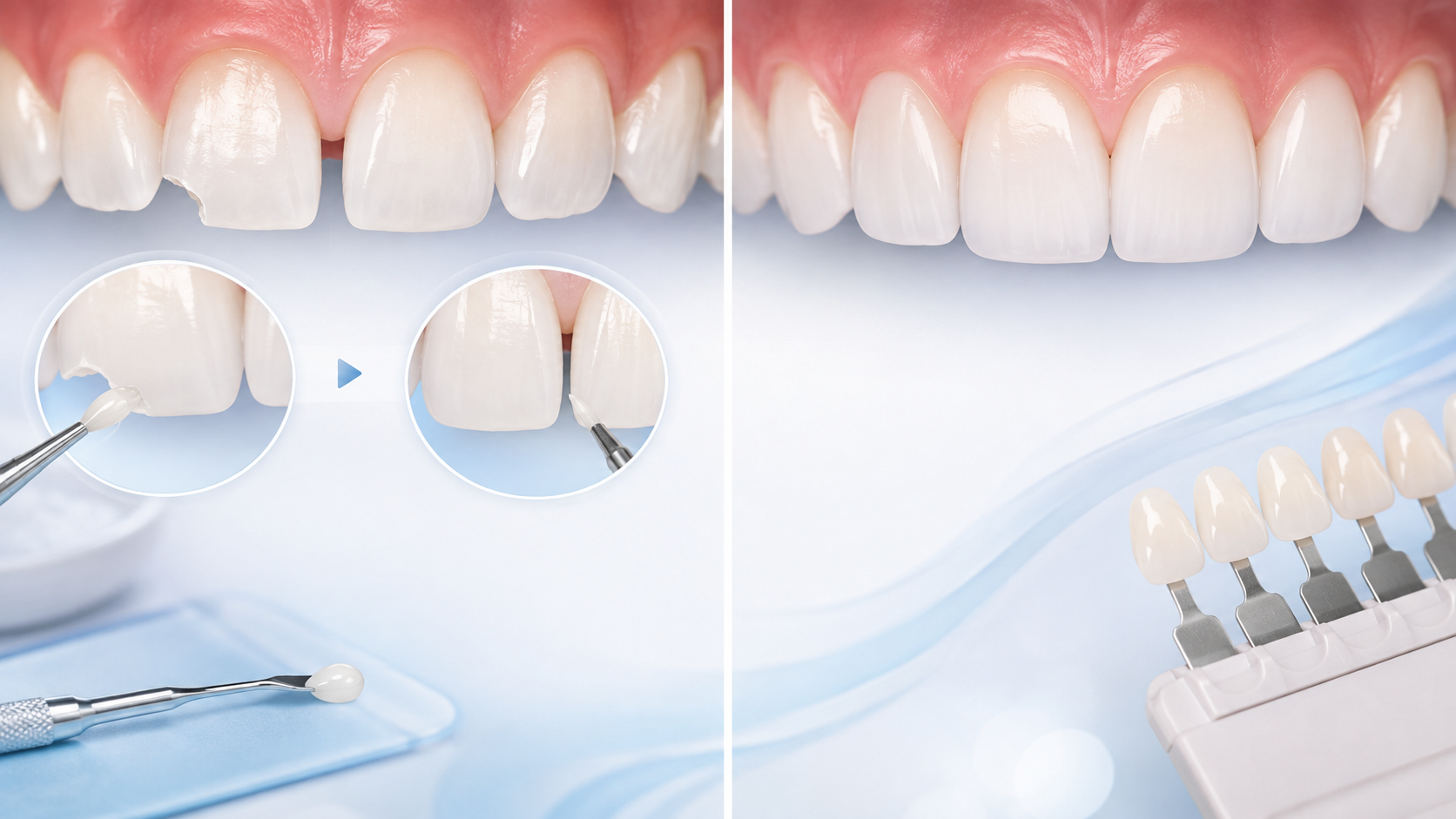
A small chip or gap can draw your attention every time you smile, but fixing it does not always require a major change. In the bonding vs veneers decision, bonding often suits one small repair, while veneers may suit several front teeth needing longer-lasting changes in shape or color.
The choice depends on tooth count, budget, desired look, and whether you are comfortable changing the front surface.
Bonding vs Veneers: Quick Answer
Choose dental bonding when the chip or gap is small, you want a lower starting cost, and you prefer treatment that can often be completed in one visit.
Consider veneers when several visible teeth need a more even shape, color, or size and you are ready for a longer-term commitment.
Bonding uses tooth-colored material placed directly on a chipped edge or beside a small gap. The dentist shapes, hardens, and polishes it to blend with nearby teeth. Little or no natural tooth surface may need changing.
It is useful for small chips, uneven edges, short teeth, and narrow spaces. Office-shaped material is usually straightforward to adjust or repair.
A veneer is a thin, custom covering placed over the visible front of a tooth. It can change shape, size, color, and spacing together. Porcelain veneers commonly take more than one appointment.
Traditional veneers normally require a permanent change to the natural tooth. The American Dental Association’s veneer guide explains that veneers can cover chips and gaps, but treatment is not reversible.
Bonding usually costs less at the beginning and preserves more of the natural tooth. It can look very natural for a small repair, although it may stain, lose shine, or chip sooner than porcelain.
Veneers cost more because each covering is custom made. They tend to keep their color and finish longer, but a damaged veneer may need replacement instead of a small touch-up.
Bonding often suits one tooth. Veneers can create more consistent results when several front teeth need matching changes. Still, covering healthy teeth is not automatically better. Start with the smallest option that solves the problem.
Discuss planned teeth whitening before either treatment. Bonding and veneers do not brighten like natural teeth, so whitening first can improve shade matching.
For one tiny corner chip, bonding is often the simpler starting point because only the missing edge is rebuilt.
When a child chips a front tooth, Dr. Lisa helps parents understand whether a simple repair is suitable now or whether timing, tooth growth, and the way the teeth meet should be considered first.
Bonding can close a narrow gap by adding a little width to the teeth on each side. The final teeth must still look balanced. Too much material can make front teeth appear bulky.
Veneers may provide better balance when several teeth have gaps, worn edges, uneven shapes, or deep color differences. When tooth position causes the space, orthodontic options may be better than making teeth wider.
A large chip, weak tooth, cavity, or repeated break may need another solution. The tooth should be checked for strength before appearance is changed.
1. How much change is needed? A tiny edge repair favors bonding. A broader smile change may favor veneers.
2. How many teeth are involved? Bonding may suit one tooth; veneers can balance several teeth.
3. What is your budget? Bonding costs less initially, but future repairs matter.
4. How long should it last? Veneers usually offer stronger long-term color and surface stability.
5. Are you comfortable with permanent change? Traditional veneers require changing the natural tooth surface.
6. Do you grind or bite hard objects? Either option can chip under pressure. A night guard may help when grinding is a concern.
Dental bonding cost depends on the number of teeth, chip size, gap width, shaping time, shade matching, and whether old bonding must be replaced. Insurance may help when treatment repairs damage, while appearance-only work may be handled differently.
At a dental bonding appointment, expect a tooth check, bite check, shade choice, treatment discussion, and estimate. Ask to see similar results and learn what happens if the material chips or needs polishing.
People comparing bonding vs veneers near me or bonding vs veneers in Bulverde, TX should choose an office that explains both choices. For families considering dental bonding in San Antonio, Dr. Lisa guides parents through timing, care, and realistic expectations for a child or teen’s chip or gap.
For one small chip or narrow gap, bonding is usually the more conservative and affordable first step. For several front teeth needing lasting changes in color, size, and balance, veneers may provide a more consistent result.
Do not choose by price or lifespan alone. Ask how much a natural tooth must change, how repairs are handled, and whether another option would protect your smile better. A useful consultation should leave you understanding the result, cost, upkeep, and alternatives.
Smiles of Bulverde offers clear guidance for chips, gaps, bonding, and veneers without treating every smile the same. Dr. Lisa helps parents understand age-appropriate choices for children and teens, while the team explains costs, appointment steps, upkeep, and alternatives so families can make informed, comfortable decisions with clear, realistic expectations.

Yes, one chipped tooth can often be matched closely. A natural result depends on shade, shape, surface shine, and how light reflects from nearby teeth. Ask to review the tooth from different angles before the final polish.
Discuss whitening before choosing the final shade. Natural teeth can become lighter, but bonding and veneers will not whiten in the same way. Finishing whitening first can help the new repair match your planned smile color.
Yes, bonding can often be replaced with a veneer later. The dentist must first remove or reshape the old material, check the tooth underneath, and confirm that a veneer is the best long-term option for your smile and bite.
Repeated chipping may happen when the repair is very thin, the teeth hit it during biting, or habits such as nail-biting and pen-chewing place pressure on it. A dentist should check the cause before simply replacing it again.
Porcelain veneers usually last longer and resist stains better than bonding. Bonding can still work well for small chips, but its lifespan depends on the repair size, bite pressure, food habits, and whether you grind your teeth.

